Rocka Display Font for Handmade Creators
If you’ve ever spent ten minutes tweaking a label just to get the right balance of charm and clarity—then you know how much a single font can shape how customers see your work. Rocka isn’t just another display font. It’s that effortlessly cool, softly brushed typeface that adds texture and warmth without sacrificing legibility. As someone who hand-letters tags, cuts vinyl for boutique packaging, and designs printable wedding suites, I reached for Rocka the moment I saw its subtle grain and confident rhythm—and haven’t swapped it out since.
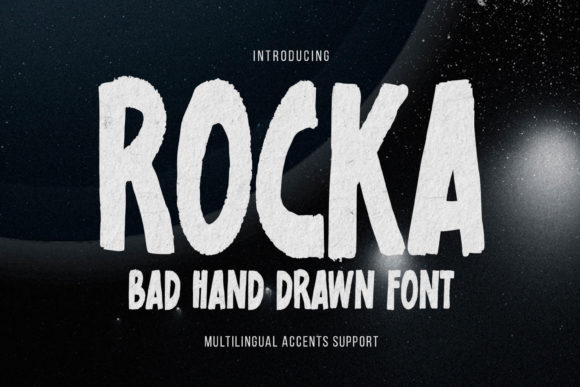
Rocka lives in the sweet spot between rustic and refined. Its brushed strokes feel handmade, like ink pulled across watercolor paper—but with enough structure to hold up on small product labels or crisp Cricut-cut stickers. It’s not overly distressed, so it scales beautifully from 8-point jar tags to 24-inch farmhouse wall signs. That versatility makes Rocka one of those rare display fonts that actually works *across* your entire product line—not just as an accent, but as a consistent voice.
I use Rocka most often for physical goods where personality matters: candle labels (especially soy wax or linen-scented lines), boutique clothing tags, greeting cards with short heartfelt phrases, and wedding welcome boards that guests photograph and remember. Its natural flow gives handwritten energy without the unevenness—so your printed invitations look intentional, not rushed. On mugs or tote bags? Rocka holds its shape even at medium sizes, and the slight variation in stroke weight catches light in a way that feels tactile and human.
For digital printables—planner stickers, quote pages, seasonal SVG bundles—Rocka shines in titles and focal words. Think “Cozy Season” on a fall-themed planner cover, or “Hand-Poured” centered above a candle mockup. It’s not built for long paragraphs, and that’s fine. Rocka is a display font by design: strongest when used for names, headlines, short slogans, and decorative emphasis. That focus keeps your layouts clean and your customer’s eye moving exactly where you want it.
Readability is non-negotiable when cutting vinyl or printing tiny sticker sheets—and Rocka delivers. The letterforms open up cleanly: generous counters in A, e, and o; clear spacing between letters; no thin hairlines that vanish at 6pt. I’ve tested it on 0.25-inch adhesive labels (yes, that small!) and it held up through both Silhouette Studio’s trace function and Cricut Design Space’s text-to-cut workflow. No jagged edges, no collapsed joins—just smooth, confident shapes that cut cleanly every time.
Pairing Rocka thoughtfully makes all the difference. For wedding stationery, I layer it over a delicate script font for names (“Emma & James”) and drop in a clean sans serif (like Montserrat or Inter) for addresses and details—creating hierarchy without clutter. For product packaging, I pair Rocka with a sturdy serif (think Playfair Display or Lora) for body text, letting Rocka carry the brand name while the serif handles ingredients or care instructions. And for seasonal craft kits—say, a Christmas ornament bundle—I’ll use Rocka for the kit title and a friendly handwritten font for playful callouts like “Hang with Love” or “Made Just for You.”
What’s included matters just as much as how it looks. Rocka comes with standard OpenType features—including stylistic alternates and ligatures—so you can swap in a more casual g or connect letters like “fi” and “fl” for smoother flow. It supports multilingual Latin characters, which means it works reliably for bilingual shop tags or international Etsy listings. File formats include OTF and TTF, so whether you’re designing in Canva, Illustrator, or Affinity Designer, you’ll have full access to its character set.
Licensing is where many crafters pause—and rightly so. Rocka is a commercial font, meaning you’re fully covered to use it in physical products you sell (candle labels, fabric patches, printed cards), digital downloads (PDF planners, SVG files for cutting machines), templates (Canva or PowerPoint), and even client work—like designing a logo for a local bakery or creating branded packaging for a small skincare line. Just be sure your license permits commercial use (most reputable font shops clearly state this), and avoid embedding Rocka directly into editable web fonts or reselling the font file itself.
In my shop, Rocka has quietly become the backbone of three bestsellers: a minimalist “Small Batch” candle label set, a printable baby shower banner collection, and a set of rustic wedding signage templates. Customers don’t mention the font by name—but they do say things like “the design feels so warm,” “the text looks hand-done but polished,” and “I kept the tag—it’s too pretty to toss.” That’s the quiet power of a well-chosen display font: it doesn’t shout, but it lingers.
Whether you're pressing foil onto kraft tags, layering heat-transfer vinyl on tees, or prepping a new Etsy listing for holiday mugs, Rocka brings cohesion and character without extra effort. It doesn’t ask you to over-design around it. It just shows up—brushed, grounded, and ready to make your handmade work look like what it is: thoughtful, intentional, and unmistakably yours.